Introduction to Management:
Management is the process of planning, organizing, leading, and controlling resources to achieve organizational goals efficiently and effectively. It refers to the appropriate methods adopted to accomplish specific tasks and is regarded as the art of obtaining maximum benefit from limited resources. Management also involves acquiring, utilizing, and operating human, financial, and physical resources effectively to achieve predetermined goals and objectives.
Main Functions of Management:
Luther Gullick’s POSDCoRB: An acronym representing the functions of management: Planning, Organizing, Staffing, Directing, Coordinating, Reporting, and Budgeting.
Koontz and O’Donnell’s Framework: Emphasizes the core functions: Planning, Organizing, Staffing, Directing, and Controlling.
Principles of Management:
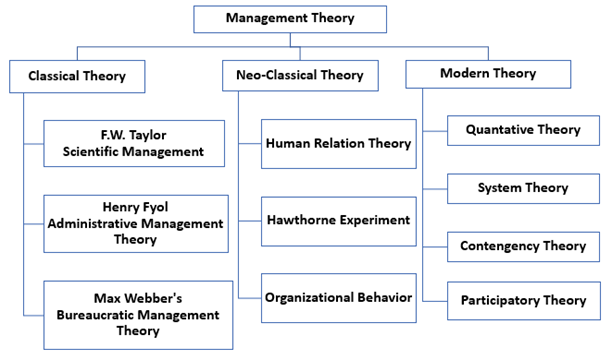
1. Classical Theory of Management (SAM):
A. Scientific Management Theory:
- Proponent: F.W. Taylor (1856–1915),
- Known as the “Father of Scientific Management Theory.”
- Core Concepts of Scientific Management Theory:
- Higher productivity,
- Increase in production rate,
- Use of standardized tools and equipment,
- Training to workers,
- Cost reduction,
- Elimination of waste,
- Quality control,
B. Administrative Management Theory:
- Proponent: Henry Fayol
- Fayol’s 14 Principles of Management:
- Division of labor,
- Authority and responsibility,
- Discipline,
- Unity of command,
- Unity of direction,
- Remuneration,
- Centralization,
- Scalar chain (Clear communication and proper flow of authority within an organization.)
- Order,
- Equality,
- Stability of personnel,
- Initiative,
- Team spirit (Espirit de Corps),
- Subordination of individual interests to organizational interests.
C. Bureaucratic Management Theory:
- Proponent: Max Weber
- Weber’s Conceptualization of Bureaucracy: Outlined in The Theory of Social and Economic Organization (1947)
- Key Aspects of Bureaucratic Management:
- Hierarchy system,
- Job specialization,
- Division of labor among workers,
- Formal rules,
- Procedures,
- Fairness,
2. Neo-Classical Management Theory (HOH)
A. Human Relations Theory:
- Proponent: Elton Mayo (Australian psychologist)
- Key Concepts:
- Focus on People: Emphasizes the importance of understanding human behavior, motivation, and interpersonal relationships in the workplace, rather than just focusing on tasks and productivity.
- Role of Motivation: Recognizes that workers are motivated by more than just money; social needs, job satisfaction, and a sense of belonging are key drivers of motivation.
- Worker’s Well-being: Prioritizes the emotional and psychological well-being of employees, aiming to improve morale and reduce stress through better interpersonal relations.
- Employee Participation: Encourages involving employees in decision-making processes, believing that participation increases engagement, motivation, and commitment to organizational goals.
- Leadership Style: Promotes a democratic leadership style, where managers act as facilitators, fostering open communication, collaboration, and employee development.
- Social Needs: Stresses that employees have social needs (e.g., friendship, recognition), and fulfilling these needs improves teamwork, loyalty, and performance.
- Hawthorne Studies: Influenced by the Hawthorne Studies (1920s-30s), which showed that employees perform better when they feel valued and are given attention by management.
- Human Factors in Performance: Recognizes that factors like job satisfaction, group dynamics, and workplace culture significantly impact performance and productivity.
- Communication: Encourages open, two-way communication between management and employees, which enhances trust, morale, and cooperation.
B. Organizational Behavior:
- Key Contributors: Frederick Herzberg, Abraham Maslow, David McClelland, Victor Vroom, Douglas McGregor
- Focus Areas:
- Study of human behavior in a business environment,
- Analysis of individual and group behaviors and their impact on organizational structure and processes,
C. Hawthorne Experiment:
- Conducted by: Elton Mayo and colleagues from 1927 to 1932 at the Western Electric Company in Chicago.
- Findings:
- Work environment significantly affects productivity.
- Working conditions influence production; financial incentives are not the sole motivators.
- Management style and leadership impact productivity.
- Job satisfaction affects outcomes.
3. Modern Principles of Management (QSCP)
A. Quantitative Theory:
- Developed by: The Mathematical School,
- Concept: Recommends using mathematical and computer-based techniques to solve management problems.
- Application Areas:
- Budgeting,
- Cash flow management,
- Developing product strategies,
- Human resource planning,
- Inventory optimization,
B. System Theory:
- Proponent: Ludwig von Bertalanffy, an Austrian biologist (1901–1972)
- Concept: Public Administration is viewed as a system with interconnected subsystems like:
- General Administration,
- Personnel Administration,
- Development Administration,
- These subsystems are interdependent, and the organization operates through inputs and outputs. The theory considers organization to the human body, where all parts must function together cohesively.
C. Contingency Management Theory:
- Developed Post-1960: By Fred Fiedler,
- Situational Approach: Emphasizes that management practices depend on situational factors.
- Concepts:
- Management is situational and should adapt to changing circumstances.
- No single best way to manage; practices must be dynamic, evolving with context, time, and conditions.
D. Participatory Management:
- Proponent: Rensis Likert,
- Concept: Encourages involving all personnel in an organization in the processes of setting goals, solving problems, and making policies.
- Employee Involvement Includes:
- Setting objectives,
- Executing programs,
- Choosing alternatives,
- Making decisions,
- Distributing benefits,
- Conducting evaluations,
Authored by Kumar Ghising researcher and public policy analyst.